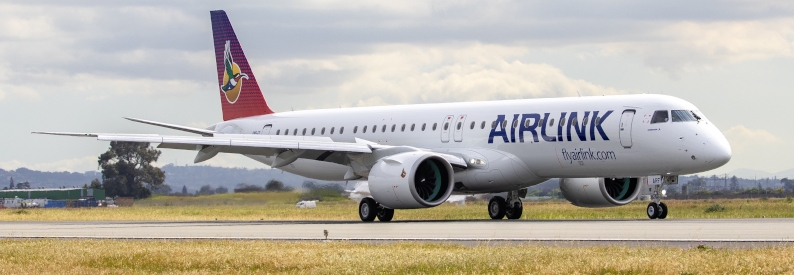
Airlink (South Africa) (4Z, Johannesburg O.R. Tambo) is considering the E175-E2 as a long-term fleet option once it completes the introduction of its E195-E2s as the airline prepares for the eventual phase-out of its ageing E135/E140 fleet, CEO de Villiers Engelbrecht said in an interview with aviation media firm AirInsight.
The South African regional carrier still operates twenty-seven E135s/E140s, which Engelbrecht said will have to be retired over the next five to 10 years as engine support arrangements with Rolls-Royce expire around 2030-31. While no decision has been taken yet, he said the E175-E2 could become relevant as Airlink reviews its entry-level capacity needs once the first ten E195-E2s are fully embedded in the network.
The E175-E2 seats 80-90 passengers, with a range of 2,000 nautical miles, and achieves 20-25% better fuel efficiency per seat than the original E175, thanks to advanced composites and fly-by-wire enhancements. Embraer has delayed E175-E2 deliveries beyond 2027 primarily due to certification delays and weak US regional demand due to scope clauses limiting regional jet sizes.
"It is an option that we have considered," Engelbrecht acknowledged, "but it is more long-term. We are going to face the retirement of the E135 fleet in the next five years, maybe even sooner. The E175-E2 will become quite interesting then!" Airlink sees the E175-E2 as a potential future entry-level aircraft, he said, but it will only assess the option after completing the introduction of its first ten E195-E2s and evaluating their network performance.
Airlink has already taken delivery of three E195-E2s, which entered service on December 22 following a five-phase certification process, as they are the first of the type to be introduced in South Africa. A further seven are due for delivery in 2026, with three more scheduled for 2027, completing the current E2 programme, he said.
To ease persistent global supply-chain constraints, the airline has bought two E190s from lessor TrueNoord, which will be parted out to provide engines and components. Engelbrecht said that the aircraft, delivered in late December, will help stabilise maintenance operations and improve fleet availability once the parts are certified and released into service. According to ch-aviation research, the units are the 19.1-year-old msn 19000055 and the 18.8-year-old msn 19000070. Both units first flew with Air Canada and later with Breeze Airways, according to ch-aviation data.
On the E195-E2’s Pratt & Whitney Geared Turbofan (GTF) engines, Engelbrecht acknowledged industry concerns but said Airlink would not have proceeded without robust mitigation measures. He said the airline had secured commitments from Embraer, Pratt & Whitney, and lessor Azorra to address engine risks, adding that performance trends were improving and that feedback from other E2 operators had provided comfort on support arrangements.
As the larger, longer-range E195-E2 opens up new markets, Airlink is planning network expansion into West and East Africa, with Central Africa also under consideration. Closer to home, the airline is preparing to launch a new route from Johannesburg O.R. Tambo to Nacala in Mozambique next month, and is planning services to Zanzibar in Tanzania, while densifying its domestic route network, Engelbrecht said.
- Type
- Base
- Aircraft
- Destinations
- Routes
- Daily Flights