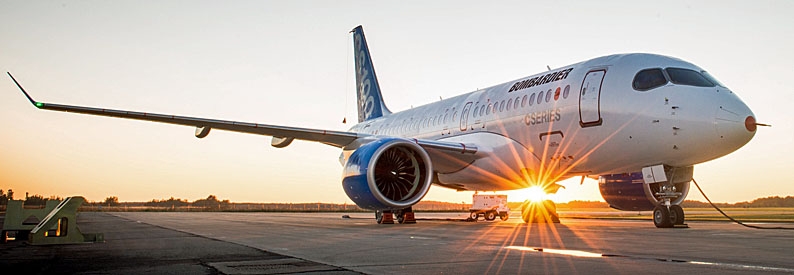
Bombardier Aerospace (BBA, Montréal Trudeau) has responded to Boeing's claims of dumping, related to Delta's purchase of seventy-five A220-100 aircraft, saying that "Boeing’s petition in this case is unprecedented in its overreach." It says that it is offering a completely different aircraft to any that Boeing (BOE, Washington National) currently produces and, due its relative newness, presents no material threat to the US manufacturer.
In its original petition to the US International Trade Commission (ITC), Boeing says the C Series could never have existed without subsidies from the governments of Canada, Quebec and the UK. It criticises the Delta Air Lines (DL, Atlanta Hartsfield Jackson) sale, saying it will lead to a precedent of 'extreme discounts' that can only be funded by subsidies. Boeing further claims that Bombardier's aggressive pursuit of sales in the ageing 100-150 seat market will have a catastrophic effect on US aircraft manufacturing .
Finally, it says that Bombardier's marketing tactics forced Boeing to make a less-than-ideal sale of its own B737s to United Airlines (UA, Chicago O'Hare), which will signal to "customers to expect lower pricing conditions for the foreseeable future".
Bombardier has refuted all of Boeing's claims, saying that the US manufacturer does not currently offer any like product to the CS100 and therefore cannot present a material threat.
"Boeing does not even make a product that competes with the aircraft Bombardier offered in the United and Delta competitions it complains about. Boeing is a giant in the market for LCA with an order backlog stretching out 7 to 8 years, while Bombardier is a new entrant."
The Canadian manufacturer rejects Boeing's claim that it lost a sale to Delta, saying that Boeing simply did not offer new aircraft in the size that Delta wanted. Moreover, Boeing would have been unable to provide any aircraft in the timeframe required.
Bombardier also says that it is filling a niche which Boeing has gradually abandoned. It says that Boeing's deliberate strategy to make larger single-aisle aircraft has left a hole in the market. It also points to its relative newness, saying that it could not present a material threat to Boeing's established business for at least many years to come.
As previously reported, Boeing contends that Bombardier sold seventy-five CS100 jets to Delta for USD19.6 million per aircraft, far below their USD33.2 million manufacturing cost. However, Bombardier says those price estimates are based on speculation. "In any event, given Delta’s marquee status and the fact that it was the launch customer for CS100 aircraft in the United States, no other U.S. airline would reasonably expect to receive the same deal as Delta."
Addressing the United sale, Bombardier says that Boeing had never been in the running for the deal, as United was after 100-seat aircraft. It was only when offered an 'unusually favourable' deal that United opted for the larger B737-700s. Bombardier says that this "was motivated not by a need to match any prior price set by Bombardier and transmitted through the market, but rather by a need to keep Bombardier out of the U.S. market. The initiation of this proceeding appears to reflect a similar strategy."
The ITC is expected to make a preliminary finding by June 12.