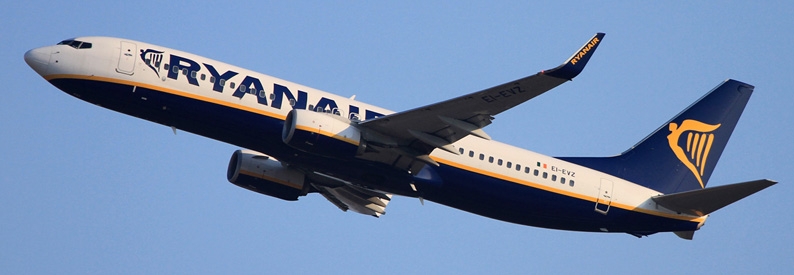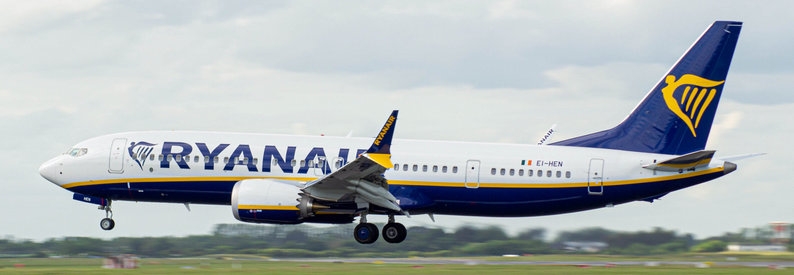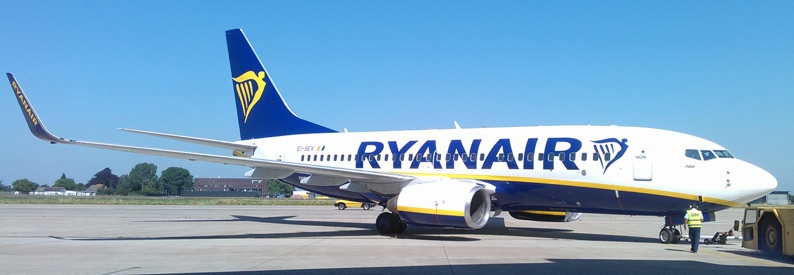
Ryanair (FR, Dublin International) has detailed cuts to its operational network as it seeks to recover from the aftershocks of a pilot re-rostering fiasco that will see a total of 2,100 flights canceled through the end of October.
The Irish LCC said in an LSE disclosure that twenty-five of its 400-strong fleet of B737-800s would be taken out of service with the onset of the Winter 2017/18 season in November, and ten fewer aircraft would operate from April 2018 (435 instead of 445). However, in terms of new aircraft deliveries, Ryanair said it would maintain the status quo between now and May 2018 and add fifty new B737-800 aircraft. But, only twenty B737-800s (instead of the usual fifty) will be added to the fleet during the winter of 2018/19.
"Our monthly growth from Nov 17 to March 18 will slow from 9% to 4%," it said. "Our full year traffic of 131 million will now moderate to 129 million, which is 7.5% up on last year. By slowing our summer 2018 fleet growth from 445 to 435 aircraft, we expect traffic to March 2019 will slow from 142 million to 138 million, a 7% rate of growth."
CEO Michael O'Leary said the slower growth would allow it to have surplus spare aircraft and flight crews available for the duration of this year's winter season as well as in summer 2018.
Among the regions most affected by Ryanair's reduction in capacity include Sofia where its base operations will be reduced 30% through the suspension of flights to Castellón de la Plana Costa Azahar, Memmingen, Pisa, Stockholm Skavsta, and Venice Treviso this winter season. Additionally, its Trapani base will also be closed this winter given the suspension of flights to Karlsruhe/Baden-Baden, Frankfurt Hahn, Genoa, Kraków John Paul II International, Parma, Rome Fiumicino, and Trieste. Ryanair will also accelerate its withdrawal from the Polish domestic market with its last flights to take place this winter as opposed to Summer 2018.
Other routes to be suspended for the winter season from November through to March 2018 include:
- Bucharest Henri Coanda - Palermo International;
- Chania - Athens;
- Chania - Paphos;
- Chania - Thessaloniki;
- Cologne/Bonn - Berlin Schönefeld;
- Edinburgh - Szczecin Goleniów;
- Glasgow International - Gran Canaria;
- Hamburg - Edinburgh;
- Hamburg - Katowice Pyrzowice;
- Hamburg - Oslo Torp;
- Hamburg - Thessaloniki;
- Hamburg - Venice Treviso;
- London Gatwick - Belfast International;
- London Stansted - Edinburgh;
- London Stansted - Glasgow International;
- Newcastle International - Faro;
- Newcastle - Gdansk;
- Thessaloniki - Bristol International;
- Thessaloniki - Paris Beauvais;
- Thessaloniki - Warsaw Modlin;
- Wroclaw - Warsaw;
- Gdansk - Warsaw.
- Type
- Base
- Aircraft
- Destinations
- Routes
- Daily Flights