
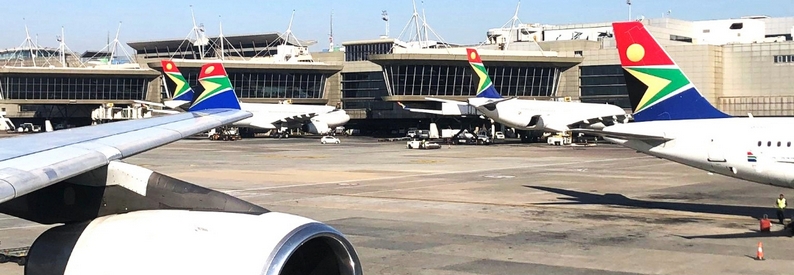
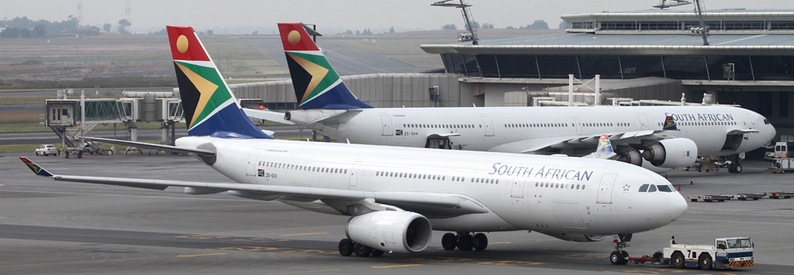
South African Airways (SA, Johannesburg O.R. Tambo) has denied media reports that it has secured a ZAR1 billion rand (USD 61 million) government-backed credit facility through a commercial bank, describing the claims as speculative and inaccurate while reaffirming its commitment to transparency, saying any material funding developments would be disclosed through official channels.
"South African Airways has taken note of recent media reports alleging the existence of a credit facility supported by a government guarantee through a commercial bank. We wish to set the record straight: the article in question is based on speculation and contains inaccurate information," spokesman Mphilo Dlamini told ch-aviation.
In a subsequent statement, the airline said: "SAA states unequivocally that it has not applied for, nor received, a government bailout."
While it did not comment on confidential discussions with lenders, the airline said engaging with commercial banks for funding and credit facilities was standard business practice, including for state-owned companies.
"SAA remains committed to prudent financial management, sound corporate governance, and operational sustainability," commented group acting CEO, Matshela Seshibe. "The airline will continue to communicate material developments through the appropriate statutory, shareholder and regulatory channels."
The airline's statement followed an unconfirmed report by the newspaper The Citizen, citing unnamed sources, that commercial lender Standard Bank had made a ZAR1 billion credit facility available to the airline. The report speculated whether the purported credit line was backed by government guarantee, secured against SAA assets, or approved by the National Treasury.
Standard Bank declined to comment to ch-aviation, citing client confidentiality.
In 2025, SAA told ch-aviation it was working to secure a financing facility that would provide additional liquidity for operations.
Later that year, former CEO John Lamola told ch-aviation the airline was looking to raise ZAR2 billion (USD122 million) as a "cash buffer" by April 2026, the end of the first year of its turnaround plan, designed to make the airline financially self-sufficient, relying solely on operational revenue and internal resources rather than government support.
Lamola said SAA had also implemented an asset-based financing model focused on raising capital for its fleet, leveraging its unencumbered property portfolio, and monetising assets such as renewing the lease of its last London Heathrow slot to British Airways to raise funds.
The South African government has repeatedly said it will no longer provide open-ended, tax-funded bailouts to SAA. In July 2025, transport minister Barbara Ceecy declared that SAA was self-funding its operations and fleet growth and was no longer reliant on government guarantees.
South African Airways is pursuing a long-term fleet renewal programme as it prepares to replace leased aircraft beginning in 2030/31. Seshibe told ch-aviation in May that the carrier had received responses to its December 2025 request for proposals (RFP) for 28 next-generation aircraft (16 widebodies and 12 narrowbodies), and was evaluating submissions from Airbus and Boeing, although no decision has yet been made on aircraft types or timeframes for decisions.
- Type
- Base
- Aircraft
- Destinations
- Routes
- Daily Flights

Editorial Comment: Added statement issued subsequently. - 09Jul2026 - 14:23 UTC