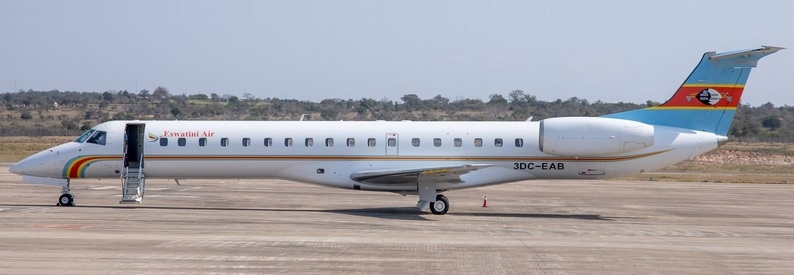
Eswatini Air (RN, Manzini King Mswati III International) expects to secure approval to carry cargo under its air operator's certificate (AOC) by November 18, 2026, opening a new revenue stream as it pursues a broader sustainability strategy. The airline is also considering acquiring a dedicated freighter should demand for cargo services prove profitable, according to general manager and acting group CEO Ndumiso Shongwe.
Addressing a stakeholders' engagement session in Matsapha on November 10, he said that for now, the airline will use the limited belly capacity of its two 50-seater E145s to carry smaller consignments, but it will consider a dedicated freighter if demand justified the investment.
Fleet expansion
The roadmap outlined by Shongwe also envisages adding a third E145 in 2027-2028 to improve schedule reliability, route profitability, and operational resilience.
With only two aircraft in the fleet, Eswatini Air has been forced to wet lease additional capacity at times when one of its aircraft needs scheduled maintenance. It recently wet leased in an E145, V5-WEJ (msn 145342), from Namibia's Westair Aviation to cover a C-check period.
Between 2029 and 2032, the airline plans to initiate a process of upgauging to aircraft with 70 to 78 seats, using the additional capacity to introduce new destinations, Shongwe said. Between 2033 and 2036, it intends to renew the fleet, grow its market and stabilise operations around the larger aircraft. The strategy will be reassessed from 2045 onwards.
He said the cargo approval is tied to an AOC recertification audit. In parallel, Eswatini Air is finalising its IATA Operational Safety Audit (IOSA), with which it expects to unlock codeshare and interline agreements. The airline completed the audit in April 2026 with an 89% score and is working to close the remaining findings, including documentation requirements. Both processes are being pursued concurrently.
Network growth
Other elements of its sustainability roadmap include expanding its route network, with Nairobi Jomo Kenyatta identified as a near-term target, and developing higher-yield routes, including Lusaka which was added in April 2026.
The airline also plans to expand its approved maintenance organisation (AMO) to serve third-party operators, establish an aviation training centre in Eswatini, increase ancillary revenues, strengthen cost management, and review its pricing strategy.
Shongwe acknowledged that a sharp increase in fuel prices from SZL9 lilangeni (USD0.54) to SZL30 (USD1.80) per litre had put considerable pressure on operations. He said the airline had introduced modest fare increases and a fuel levy to help offset the additional costs.
Market impact
While load factors remain at 58% three years since the airline was established in 2023, Shongwe said Eswatini Air had helped bring down fares in its market, while passenger traffic into Eswatini had grown more than five-fold.
Eswatini Air currently serves five regional destinations, including Johannesburg, Cape Town International, Durban King Shaka, Harare International, and Lusaka.
- Type
- Base
- Aircraft
- Destinations
- Routes
- Daily Flights