Financing remains the biggest hurdle in Africa - a key focus market - for the new D328 Eco turboprop being produced by Deutsche Aircraft (Oberpfaffenhofen). The new type aims to address the needs on the continent for the replacement of up to 400 airframes in the 30- to 50-seater range that are more than 30 years old.
This is the word from sales director Reinhard Schwaiger. "Our goal is to become the backbone of regional aviation in Africa," he said in an exclusive interview with ch-aviation.
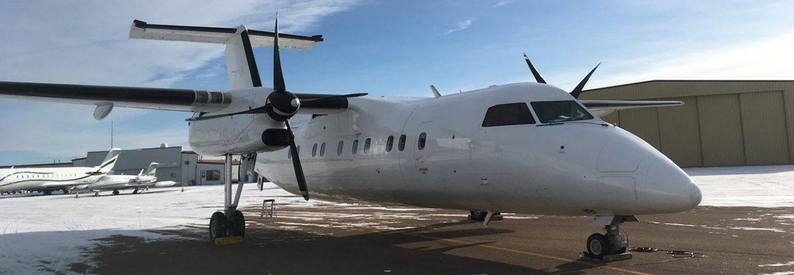
However, the German manufacturer knows that financing, rather than appetite, is the main obstacle to fleet renewal in African regional aviation, a market long regarded as hostile to expensive new aircraft and which is more comfortable with cheaper, second-hand models. Many African operators continue to rely on ageing De Havilland Aircraft of Canada Dash 8s, largely because access to capital remains limited.
Affordability
A case in point is Kenya's Safarilink Aviation (F2, Nairobi Wilson), which is monitoring the development of the D328 Eco. However, CEO Alex Avedi has told ch-aviation that the model's high initial costs may limit near-term adoption. "It completely fits the billing. It's just that it's new, and the price point is problematic for regional economics," he said.
Another Kenyan operator, which asked not to be named, echoed this view. "It's a great type and outperforms many other aircraft in that segment. It's significantly faster than the DHC-8-100 and has better field performance. [It] would make a lot sense for us, however [with] our business model and the sectors we serve, [we] wouldn't be able to afford the cost of operating a new aircraft. It's all about the financing and insurance cost."
The D328 Eco would compete against the ATR42-600 in the 40-50 seat regional airline segment. The French manufacturer has made inroads selling newer ATR42-600 and ATR72-600 turboprops to African airlines in recent years, including its largest-ever African order for sixteen ATR72-600s from Air Algérie in 2025.
"Of course, financing is needed," Schwaiger responded. Deutsche Aircraft last year recruited a corporate finance director from Airbus to help structure deals that would make the D328 Eco accessible to African customers. The manufacturer is also in active discussions with all lessors and banks experienced in aviation finance, with the aim of offering lease structures that can compete with the economics of used aircraft.
"In the [African] market, operators complain about the lack of spare parts availability," Schwaiger said. "The older the aircraft get, the higher the maintenance cost. You really have to look at the whole business model and the long-term cost of the airframe."
Efficiency and sustainability
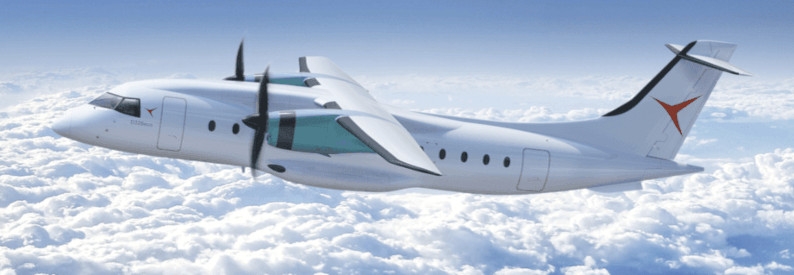
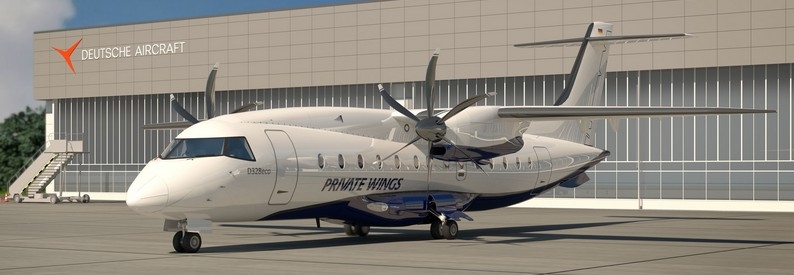
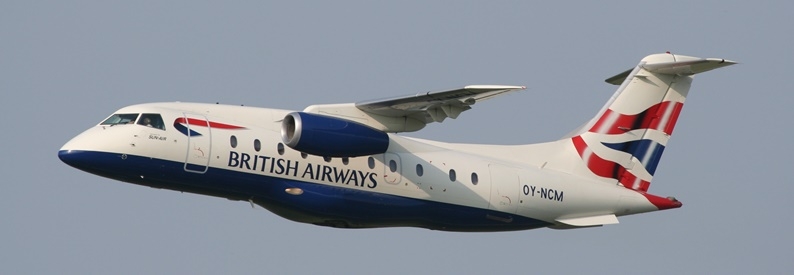
Still in development, the D328 Eco builds on the legacy Dornier Do328-100 with enhancements for efficiency and sustainability. Entry into service is targeted for late 2027 with launch customer Private Wings (PWF, Berlin Brandenburg), which has ordered five aircraft.
Key upgrades include a two-metre-longer fuselage to accommodate more passengers (40); 100% compatibility with sustainable aviation fuel (SAF); an avionics upgrade to Garmin G5000 enabling advanced operations; lower fuel burn and emissions; reduced maintenance costs; and a range of 655 nautical miles (1,213 kilometres). The aircraft will be built entirely in Germany, with final assembly taking place in Leipzig/Halle, where the production line is currently under construction.
"The use of SAF is a bit of a red herring for Africa due to availability, cost, and storage/distribution. We simply cannot obtain any in our part of the world. And secondly, 100% SAF is roughly four times the cost of regular JET A-1 fuel," commented an industry source.
Market potential
According to Schwaiger, Deutsche Aircraft is targeting a mix of customers in Africa, including regional airlines, tourism operators serving high-yield customers, and oil and gas companies with fly-in, fly-out (FIFO) services. He underscored the importance of matching financing structures to individual business models. "I believe it is also a matter of speaking to the right operators," he said.
Schwaiger also sees a role for the D328 Eco in opening new routes, or as feeders. "It’s easier to fill a 40-seater than a 70-seater when you want to start a new route," he noted.
Regulation is another factor nudging operators toward newer equipment. Kenya, for example, is banning older types such as the Fokker 27 and Fokker 50.
Deutsche Aircraft is also banking on broader market fundamentals. IATA forecasts show African air traffic demand growing faster than capacity. In November 2025, African airlines were the standout performer of all regions, with an 11.2% year-on-year rise in demand. Capacity was up 8.5% year-on-year, and it still only accounts for 2.2% of the total global passenger market. "Africa has a big and young population, and the growth potential is there," commented Schwaiger.
Still, the manufacturer acknowledges that uptake will not be immediate. "I’m not saying it’s easy, and I’m not saying it can be done in one or two months," Schwaiger said, noting that sales cycles in Africa often run two to five years.
For Deutsche Aircraft, success may hinge on securing one or two early adopters willing to make the leap from used aircraft to new technology. "It takes one brave company who makes the first move, and at some point I believe the others will follow," he said.