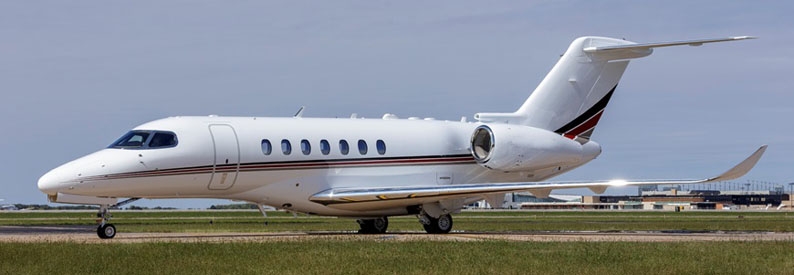
NetJets Aviation (EJA, Columbus John Glenn, OH) has petitioned the United States Federal Aviation Administration for an exemption enabling Global 7500 and Global 8000 ultra-long-range Part 135 operations up to the aircraft's maximum endurance, described as between 16 and 17 hours, with four-pilot crews. The company is further seeking an extension of crew duty limits to support these missions.
The request, filed on June 12 under docket FAA-2026-3840, targets 14 CFR §135.269(b)(2)-(4) regulations, which govern flight deck duty periods, duty hours, and time aloft for unscheduled operations conducted with three- and four-pilot crews.
NetJets seeks relief under these provisions to permit missions up to the Global 7500 and Global 8000 maximum endurance, estimated at 16 to 17 hours, with four-pilot crews, alongside a one-hour extension to the maximum duty period, raising the limit to 21 hours to accommodate extended operations. Comments on the petition are due by July 2.
This filling follows the delivery of the first factory-built Global 8000 to NetJets in early 2026 and the launch of a programme to convert nineteen Global 7500s to the newer variant, which features extended range. NetJets expects to operate a fleet of twenty-four Global 8000s.
ch-aviation contacted NetJets for further details.
Fatigue and regulatory concerns
By June 17, four comments had been submitted to the docket. The Private Aviation Safety Alliance, a non-profit aviation safety data platform, urged the FAA to deny the petition, arguing against operator-specific exemptions and warning of broader regulatory and safety implications.
“If the FAA believes there is merit to reconsidering the current limits for ultra-long-range Part 135 operations with augmented crews, the agency should defer action on this petition and instead initiate a broader process to evaluate such operations on terms equally available to all affected certificate holders,” the comment said.
PASA emphasised that while aircraft such as the Global 7500 and Global 8000 can remain airborne for extended periods, human fatigue is governed by circadian rhythm disruption and sleep pressure, not aircraft performance alone. The organisation further called for disclosure of any fatigue-management data or operational practices underpinning the request, rather than allowing such measures to become a competitive advantage.
The group additionally pointed to recommendations issued in 2023 by the Part 135 Pilot Rest and Duty Rules Aviation Rulemaking Committee, which proposed a science-based framework linking duty limits to factors such as onboard rest facilities and alertness management programmes, urging the FAA to implement those recommendations before granting additional operational flexibility.
Three further comments were submitted to the docket. Dennis Cotton, a Global 7500 crew member, stated that existing crew rest facilities are insufficient for such operations, citing galley door interference, thin mattress pads, and cabin noise as disruptive to rest. “It barely works with the missions we fly now,” he noted.
An anonymous NetJets crew member suggested the proposal is primarily driven by cost-saving in crewing rather than operational necessity. “I've flown several augmented Global missions. Even with four pilots, these trips are already a gruelling long day,” the crew member said, adding that under current regulations, with an allowed 20-hour duty period, pilots can often be awake for 24 hours or more by the end of the duty period.
Another anonymous commenter, a business jet user, urged the FAA to assess impacts on cabin attendants and questioned how acceptable fatigue thresholds would be defined and validated. The commenter challenged claims regarding the adequacy of crew rest facilities, arguing the petition does not clearly demonstrate unique features that would justify extended flight and duty limits.
- Type
- Base
- Aircraft